

zondag 30 december 2012


zaterdag 29 december 2012
How to motivate the unmotivated?
How to motivate the unmotivated?
Nothing
great was ever achieved without enthusiasm.
Ralph Waldo
Emerson

The best
approach is to start with carrots and move to using a stick only if carrots
bring no results. But since your team is up against the wall there's no time
for just carrots. Senior management has already threatened the stick, so your
job at this point is to be fair but be firm.
Because
research shows that only seven percent of workers know how their work contributes
to the big picture, let's start there.
A. Hold a
meeting to connect their work with the big picture.
1. Remind
people of the vision / mission of the company and that everyone in the company
is on the same team.
2. Inform
them you've personally observed unacceptable performance and that it's these
types of actions that give them their reputation as a "toxic energy
dump."
3. Ask them
to think through their near-term future. Do they want to work elsewhere, or do
they want to be part of the company team and its vision and mission? Don't
worry if people opt to leave. If they won't support the company, they shouldn't
be there.
4. State
that people not dedicated to the company vision and mission will be identified
by the quality of their work. Those people will be asked to find work
elsewhere.
5. Ask what
the department can do as a team to help the company achieve its goals. Write
down what they say, as this begins to form goals for your department.
6. As a
team, turn these ideas into SMART Goals with specific actions and deadlines.
B. Select
your best people and put them in charge of tracking progress on the goals, one
person per goal. They should be 100% responsible for ensuring those goals are
met. Make progress and achieving those goals part of those employees'
performance reviews.
C. Revisit
and rewrite job descriptions for all employees in the department. Then use
those job descriptions to train people and also for evaluating them .
Motivation
is fire lit from within. You can't light that fire, but you can create the
conditions for that fire to burn brightly.
donderdag 27 december 2012
PSS
PSS -
'Professional Selling Skills'
We have all
heard the term Professional Selling Skills, the highly structured selling
process pioneered by the Xerox photocopier sales organization, but how many of
you have heard the term Unprofessional Selling Skills? Although the terminology
is not commonly known, many salespeople are actually practicing it. Professional
Selling Skills (or “PSS”) is not about throwing a price on the table, allowing
the customer to respond to it, and then offering up a discount. To succeed in
today’s sales world, it takes a person who is dedicated to continually
improving their selling skills. This means they’re willing to invest their time
and money into learning as much as they can about how to sell more effectively.
They’re not afraid to try new things and, most importantly, they embrace an
attitude that drives them to always find success. Start today by examining how
“professional” your skills really are and then make the changes where
necessary.
woensdag 26 december 2012
The Socratic Selling Method
The Socratic Selling Method

Socratic Method: A method of teaching or discussion, as used by Socrates, in which one asks a series of easily answered questions that inevitably lead the answerer to a logical conclusion.
- Respect
the customer
- Help the
customer think- Help the customer make decisions.
The most
common complaint about sales people is, from both customers and sales managers
is that sales people simply talk too much. And since most of us do indeed talk
too much, what do you think the second most frequent complaint we hear about
sales people would be? Sales people don't listen.
One simple
way to combat both of these short comings is to integrate the Socratic Selling
Method into our transactions. We can trace its origins all the way back to 400
BC! That's when Socrates, the famous philosopher from Athens
The
customer owns the past.
The
customer has no stake in the future – until the past has been dealt with.Help the customer tell the story.
We learned
early on in our selling careers that the person asking the questions has
control. It's just that most of us only take the time to learn questions that
help us land the customer on a particular unit and close the deal. (remember the
ABC: always be closing) These are questions that our customers perceive as only
serving us, not them. With Socratic questioning, each question draws us and our
customer closer. We get a better understanding of how best to serve our
customer. They get a feeling of being valued and understood. We both join our
strengths in a collaborative effort to satisfy their needs. The result is a
less stressful, much less combative, and much shorter (time wise) transaction.
Here's what's involved:
First, we
need to open the transaction with what's called a "Socratic opener". Typically,
this occurs right after our greeting and it gives notice our intention of
serving our customer's needs and not ours. If they mention a product/service
they are interested in, we say, "Mr. Customer, I'm fully prepared to
discuss the xxx with you, so first let me get your perspective on it, that way
we can focus our time together on the things that interest you the most."
If they
don't have a particular product/service in mind, we can modify it this way,
"Mr. Customer, I'm fully prepared to help you make the best choice, the
one that's right for you. So, first let me get your feelings about your needs,
and that way we can focus our time together on the things that interest you the
most."
By
announcing we are "prepared," we demonstrate that we are responsible
and competent. By acting responsibly, we begin the building of our own
credibility. By inviting our customer to tell us what is important to them, we
show them that we value their time and their input. We also begin the
transaction in a collaborative manner. By stating we want to focus the time
spent together on what they think is important, we give our customer the
control most buyers long for. We also tell them that we won't be wasting their
time.
Next, we
need to help them put more of their information out on the table by using
Socratic probes. Socratic probes are nothing more than easily answered
questions. "Tell me more...", or "What else should I know
about...", or "Why is that important to you?", or "How will
you be using...", or "What else would help me understand...", or
"Could you please expound upon...". These questions are also very
easy for us to ask. As long as we have the front part of the question committed
to memory, the rest of the question just sort of asks itself based on what our
customer has already told us.
Another
important aspect of encouraging our customers to share their wants, needs,
fears, and goals is that, once they do, our solutions will be more credible. Now
our suggestions will be much more appealing because they have been tailored
specifically to them. By allowing our customer to do the majority of the
talking, we also get to pace two of their most basic human needs. We get a
chance to help them feel valued and understood.
Another
benefit of Socratic probes is creating urgency. Often salespeople still use time
of the month, sales quotas, or expiring incentives to create urgency. What most
salespeople do not realize is that many of their customers perceive these
"reasons" as only benefiting the dealership and salesperson ("Do
I really have to care about your sales quotas to get a good deal?") or,
even worse, as artificial sales ploys ("How long have you guys had rebates
now? Twenty years? Isn't it mysterious how they always seem to be 'just about
to end' right about the time I decide to buy a car?"). The customer goes
along with them, of course, as they do with most other dated sales practices,
as simply something they have to put up with to buy a car.
We can use
Socratic probes to create truly relevant urgency. We can ask: "Why
now?", or "You said you weren't in a hurry, right? That's
interesting. So what made you visit a dealership at this time?", or
"What makes this urgent?", or "What made you get started
today?". This is information we can use later to help create real urgency
that is relevant to our customer. These are our customer's reasons to do
business based on our customer's needs. Now to create urgency, we only have to
remind our customer about what they said was urgent enough to make them set
foot on a car lot.
Major
buying decisions are made emotionally first and then we'll grab whatever logic
is available at the time to justify the emotional decision we've already made. We
can get a handle on what our customers are feeling by asking questions like:
"What worries you the most about this?", or "I can tell you're
frustrated by this, how come?", or "What do you want to avoid this
time?", or "Why is this important to you?", or "How will
this affect you and/or your company?", or "How does that make you
feel?".
I suppose
now would be a good time to remind ourselves that in order for these questions
to have their desired effect, we need to listen to what our customer is telling
us. The skill of Active Listening is one that most sales people ignore and is
one of the skill sets that separates the good sales person from the truly
excellent sales professional.
The four
elements to Active Listening are:
- Attentive
Body Language (head nods, eye contact, smiling, etc.)
- Verbal
Attends (small grunts like "uh huh", "okay", "sure",
"I see", etc.) - Leading Questions (open-ended questions that encourage them to talk more)
- Restate (paraphrasing back what our customer has said to us).
Active
Listening is not simply waiting for our turn to talk. It's not interrupting
them to show that we already know what they are talking about. It's not
interrupting them to interject how our product or service satisfies the need
they just shared with us. It's not anything more than simply allowing our
customer to completely share with us their story, then playing that story back
to them, and gaining clarification or confirmation by asking: "Do I have
it right?", or "Did I hear you correctly?", or "Am I
getting the picture?", or "How's that sound?", or "Did I
miss anything?".
You haven’t
listened until you can show you have listened.
We continue
to ask the questions we've all been taught while landing them on a specific product/service,
performing a good feature/benefit presentation.
Then we can
advance the decision making process by asking easily answered questions like:
"If you were to go ahead with this, how would you like your insurance
agent updated with the new vehicle info?", or "If you decided to
proceed, when would you like the xxx installed?", or "If you were
shown three compelling reasons to do business with a particular dealership,
would you be willing to at least keep an open mind?", or "On a scale
of one to ten, ten meaning you love it and are ready to own it, one meaning you
hate it and wouldn't even take it if it were given to you, where would you say
you are?", then, "What would have to occur to make it a ten?".
In these
questions we reduce the pressure by using conditional words like: if, were to,
and would. We also reduce the pressure by eliminating words like: us, I, me,
and we. We can make them even easier to answer by excluding our product brand
or dealership name and by refraining from the use of words like: now, or today.
When they answer us, we can assume the "us", "our product",
"our dealership", and "today". Besides, we'll have plenty
of time to be "more concrete" later on if the need arises.
In the
negotiations, our goal is to keep the process one of collaboration and not one
of confrontation. We can start by stating their interests through summarizing
what our customer has told us concerning their wants, needs, time urgency, and
feelings. We get their clarification or confirmation by asking: "Did I get
it right?", or "How's that sound?", or "Did I miss
anything?". Then we make our proposal based on what they've told us,
making sure we tie the recommendations to benefits and tailor them to our
customer. We then seek their approval by asking: "What's your feelings
about this?".
If an
objection comes up, we can give them an answer tailored specifically to them by
what they have stated to us already. If a tailored answer isn't clear to us, we
can get clarification by helping our customer think it through by asking:
"Why is that important to you?", or "Why is that important right
now?", or "Why do you ask?", or "What is it you're wanting
to discuss?".
If they
make a counter offer that is not acceptable, we can preserve the collaborative
environment by
- stating again their interests (their wants, needs, time urgency, and feelings)
- restating their position (whatever their counter offer is)
- saying, "It's important to me that you understand why what you're asking is a bit more than they are able to do."
- giving the reasons why we can't do what they are asking
- saying, "May I share with you a solution I think will be acceptable to everyone?"
- making a counter proposal.
Don’t
negotiate just to get the sale. Negotiate to upgrade the sale for yourself and
the customer.
Help the
customer make the buying decision. Regain the momentum by summarising. Make a
diary statement. “In order to do this for you, let’s get out our diaries and
schedule the next steps.” Specify the next steps:
- Actions the customer wants you to take.
- Actions you offer to take.
- Actions you want the customer to take.
- Attach dates to all action steps.
Time is the recorder of responsibility. Close on a point in time.
As with any
new skill, the Socratic Selling Method requires lots of practice and refining
to our vocabulary, personality, and philosophy of doing business. Making the
sales transaction one of collaboration and not one of confrontation is possible
when we engage our customers in the process. By asking easily answered
questions, we not only gain insight into what our customer's dominant buying
motives are, but we also help our customers feel valued and understood. By
taking the extra time to get to know and engage our customer, we actually
dramatically speed up the buying process.
We've all
heard this before, "Our customers don't care how much we know until they
know how much we care." Socratic Selling gives us the opportunity to
demonstrate to our clients that we really are different and that we actually do
care.
zaterdag 22 december 2012
Motivate your sales team
How to motivate your sales team?

Foster a
team environment
Coach and
mentor them
Create some
friendly competition
Listen to
their pain points
Give them
the tools they need to succeed
Show them
the money and appreciation
1. Foster a
team environment
Many
companies find that a team mindset can provide great results.
Do your
sales people feel like a team or is everyone out there as a lone ranger? Even
if the nature of your business requires people to work individually there is
value in having a shared sales goal and business identity.
When people
communicate, they can also begin to collaborate better. Senior salespeople can
help junior salespeople. Sales conferences, group training, team meetings, team
building events, and social gatherings can all help you foster a better team
environment.
2. Coach
and Mentor Them
Sales is an
evolving role. Today it’s not about just selling but about fostering
relationships with customers. Foster relationships with your sales people and
you’ll get better results from them just like you will with your clients.
Coaching
and training sales staff can result in significant improvement in results. People
respond to individual feedback on performance. You may consider implementing
one-on-one meetings on a monthly basis with all of your salespeople, for
example. This is where you can give praise when it’s due and help struggling
salespeople overcome challenges as well.
3. Creating
some friendly competition
Salespeople
tend to be competitive by nature and motivated by money. Internal contests can
inspire great results and can also be a great way to foster team collaboration,
too. Regular contests can make a big difference in the mindset and the morale
of your sales team.
4. Listen
to their pain points
Regular
sales staff meetings and individual one-on-one meetings can help address issues
and problems that your salespeople are experiencing. Listen to your salespeople
and act on their concerns. A happy and steam lined sales team leads to
motivated and long lasting employees.
5. Give
them the tools they need to succeed
Do you have
outdated sales tools? Do your sales tracking, CRM, and order fulfillment tools
help salespeople do their jobs or do they make life difficult or just add
another step in their day? Upgrading to the sales right tools can help your
staff become better at what they do. Your efforts of continuously improving
processes in the company can translate to a salesperson being able to
continuously improve his or her results.
6. Show
them the money and appreciation
Recognize
excellence with compensation. You can do this with cash, gifts, plaques of
appreciation, and so on. This probably seems pretty obvious but how long has it
been since you reviewed your company’s compensation plan? Is it considered competitive for your
industry? Are you rewarding the performers and inspiring those who are
struggling to try a little harder? Regularly review compensation and incentives
to make sure you continue to inspire people through rewarding excellence.
Whether you
implement some of these suggestions or all of them, continually working to
motivate your staff can yield some great results!
Source:
zondag 16 december 2012
Why a Sales Director is important
Why a great Sales Director is important
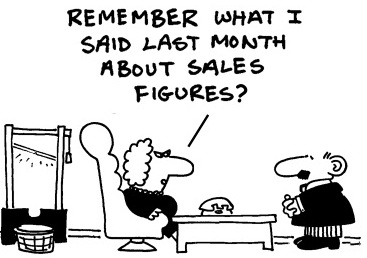
What’s the
best? A team of excellent salespeople with an average manager or a team of
average salespeople with an excellent manager?
Many will
choose for the team of excellent salespeople:
•"It's
salespeople — not managers — who develop and nurture the customer relationships
that drive sales."
•"Replacing
one average manager is easier than replacing an entire team of average
salespeople."•"An excellent salesperson doesn't need managing."
Others will
argue for the excellent manager:
•"Excellent
managers consistently recruit the best sales talent. 'First-class hires
first-class; second-class hires third-class.'"
•"Excellent
managers motivate excellent salespeople, develop average salespeople to make
them excellent, and keep the entire team engaged and aligned."•"Excellent salespeople make sales today, but eventually they retire, get promoted, or get wooed away by a competitor."
Clearly,
the best sales forces have both excellent salespeople and excellent managers. A
team of excellent salespeople will win sales and make this year's goal,
regardless of who the manager is. But the success of that team will be
short-lived. Eventually, an average manager will bring all of the salespeople
that he manages down to his level. On the other hand, an excellent manager will
bring excellence to all her territories. An excellent manager may inherit
average salespeople, but in the long run he will counsel, coach, motivate, or
replace salespeople until the entire team is excellent.
Companies
that have winning sales forces start with excellent managers. Most sales
organizations focus considerable energy to build a team of excellent
salespeople, yet regrettably, they focus too little attention on building the
management team, which is truly "the force behind the sales force." Consider
the following evidence.
Role
definition: Most companies have a job description for salespeople, and many
have a defined sales process specifying how salespeople should work with
customers. But too many companies don't do a good job of defining the more
varied responsibilities of managers. Managers must play three roles, people,
customer, and business managers, so they get pulled from all sides. We hear all
the time about "role pollution" in the manager's job. Without role
clarity, managers execute tasks that are urgent or within their comfort zone,
rather than focusing on what's most important for driving long-term
performance.
Selection:
Companies devote substantial energy to recruiting the best sales talent, but
when it comes to managers, most simply select their best salespeople for the
job. Yet what it takes to succeed as a salesperson is very different from what
it takes to succeed as a manager. Unless you select salespeople who have strong
managerial tendencies, in addition to respectable sales skills, your sales
management team will be average at best.
Development:
Too often, when sales managers come into their jobs after having been
successful salespeople, their company expects them to know how to manage with
minimal guidance. Most of the companies spend training their sales forces every
year, very little gets directed towards sales managers. The result is
inconsistent competency across most management teams, as new managers struggle
to make the critical transition from salesperson, and experienced managers
can't keep up with ever-changing job demands.
Support:
Sales managers typically rank third, behind salespeople and senior sales
leadership, when it comes to prioritizing sales force support initiatives (such
as access to support personnel and resources, and data and tools that enable
good decision making and increase efficiency). Rarely do managers get enough
support resources for getting everything done — and done well.
Sales
managers serve as key points of leverage for driving long-term sales
performance. It's a mistake to underinvest in this group. By building a winning
sales management team, you can capitalize on a high-impact, tangible
opportunity to drive sales effectiveness and top and bottom line results.
zaterdag 8 december 2012
Best Practices in Sales 2.0
Best Practices of top performing salespeople
The big difference between Sales 2.0 and Sales 1.0 (= old school
selling) is where sales people should spend their time and energy in the sales
process.
The graph illustrates this point. It shows the time and
energy sales people need to put into the sales process graphed against the
stages in the sales process.

At a high level the four stages in the sales
process are:
1. Prepare
2. Prospect
3. Progress (move opportunities towards closure)
4. Close
2. Prospect
3. Progress (move opportunities towards closure)
4. Close
Many
people wonder what separates a top performing salesperson from the rest of the
pack. In most cases, it’s because they apply a number of best practices in
their daily routine.
1. They set HIGH TARGETS and goals. Top performers
don’t wait for their manager to issue an annual or quarterly quota. They set
their own goals that are usually more ambitious than the corporate targets.
2. They carefully PLAN their quarter, month and week,
as well as their daily schedule. Too many salespeople fly by the seat of their
pants and only look at the day or week ahead instead of planning their month
and quarter. Look at the big picture.
3. They set OBJECTIVES for every sales call. It is
essential to know exactly what you want to accomplish before you make your call
(face-to-face or telephone).
4. They ASK high-value questions that probe to the
heart of the issue. Sounds simple but most salespeople fail at this and ask
weak, feeble questions. Top performers are comfortable asking tough questions
that make their prospect think.
5. They LISTEN carefully to what their prospects and
customers say instead of waiting for their turn to speak. Listen to your customer. You can ask all the
questions in the world but if you don’t hear what people tell you, you won’t be
able to present the proper solution.
6. They CLARIFY the issue when they are unclear what
their prospect means. People often say things that are unclear and most
salespeople assume they know what their prospect means. Top performers take the
time to fully understand by asking “What do you mean by that?” or “Can you
clarify that for me?”
7. They WAIT TO PRESENT their product, service,
solution or idea until they know exactly what their prospect’s situation is. The
majority of salespeople jump too quickly into their “sales pitch” but top
performers are patient and wait for the right moment.
8. They begin every sales presentation with a brief
RECAP of their understanding of the prospect’s situation. Again, a simple
concept but one that is greatly ignored by many salespeople. A quick summary of
your customer’s situation gives you the opportunity to ensure that your
presentation addresses their key issues.
9. They know how to ADAPT their sales presentation if
their prospect’s situation has changed. Making changes on-the-fly is
challenging but it is one way to stand out from your competition. Learn how to
modify your presentation when a customer’s situation has changed from the time
you initially met to the time you are delivering your presentation.
10. They know how to properly and effectively POSITION
their product, service or solution. The vast majority of salespeople fail
miserably at this. They talk, talk, talk but usually end up talking about
aspects of their product or solution that have little or no relevance to their
customer’s situation.
11. Their sales presentations FOCUS on the prospect. Most
sales presentations focus on the seller’s company, their product, or other
trivial information that is of no interest to the customer.
12. They are PREPARED for potential objections. Top
performers anticipate objections and plan their response before their sales
call.
13. They always
establish the NEXT STEPS. Decision makers are busier than ever which means they
are more difficult to connect with. Avoid losing contact with a prospect. You
do this by agreeing on the next steps after every sales call. Do this in
face-to-face meetings and telephone calls.
14. They
FOLLOW-UP after the initial call or meeting. Many a sale has been lost because
the sales rep failed to follow up after the initial call. You cannot rely on
your prospect or customer to call you; you need to take this initiative. Set
this up during your call or meeting.
15. They
PROSPECT continually to keep their pipeline full. It’s not uncommon for sales
reps to experience peaks and valleys in their sales. This is usually a result
of failing to prospect for new business on a regular basis. Avoid the highs and
lows and schedule time to prospect for new business every week.
16. They deal
with the DECISION-MAKER whenever possible. Dealing with people who have little
or no buying authority is a waste of time. However, many salespeople fall into
this trap because it is easier to connect with people other than the decision
maker. And that may be true. However, in the long run, they end wasting their
time because they don’t close the deal.
17. They look
for ways to KEEP IN TOUCH with their customers. A sale is not a one-time deal. However,
you need to find ways to keep your name in your customer’s mind to prevent a
competitor from squeezing in. Top performers incorporate this into their
schedule and make it a priority.
Abonneren op:
Posts (Atom)